Apart from discovery, I believe that communication is a key part of play. Children learn to name objects through play, make requests, comment and negotiate with peers. But what if your child has no or limited language, be that because they are still young or be that because they have a developmental issue? How can they communicate during play? How can they develop deeper connections with peers that language affords us?
One of the most effective tools I used when teaching children with no speech or limited speech was an Aided Language Display or ALD. With an ALD I could give children the opportunity to open up and communicate with me on a certain topic or activity. After much frustration I was finally able to understand more about the children's likes and dislikes. I could easily attend to their needs because they were able to easily make requests. And being able to make comments like "wow" and "oh no" really made the play session come alive. I was now becoming more a play partner than just the teacher who was watching a child silently play on their own.
Once more children were using the ALD's successfully, I started witnessing moments where the children were starting to communicate simple ideas with each other. In special developmental education this is like witnessing lightning strike before you. From my experience it's just that rare. And with more communication came more willingness to play, and more willingness to engage with others which in turn meant more laughter and more fun!
So what exactly is an ALD? Well an ALD is often a one sided A4 page that has printed on it a set number of cells usually between 6 and 20. Within each cell is a picture communication symbol or PCS. The PCS's are related to a particular activity and are chosen so that anyone can by pointing to the symbols and make simple sentences for requesting, commenting and questioning.
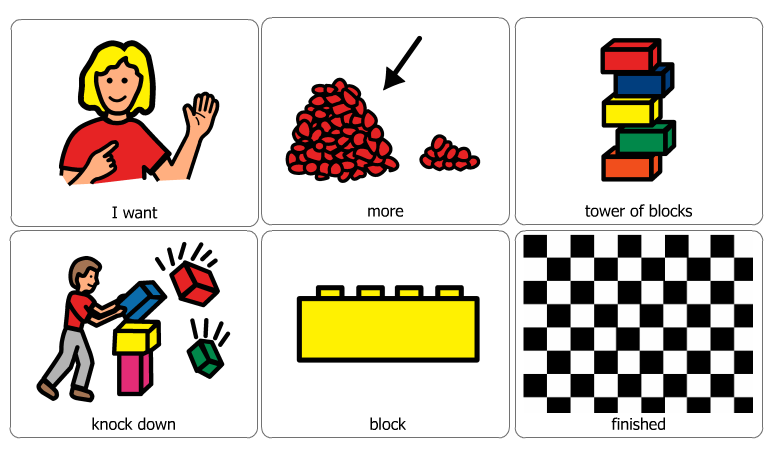 |
| Very simple 6 cell ALD for building a block tower |
Below is a picture of an ALD I made for the
Marble Maze game I posted earlier.The symbols I've used are from Boardmaker and are typically used in special educational settings. (save picute and print for your own use)
As you can see the child can point to a series of cells to make requests like "I want a block" or "I want to build a maze". They can also instruct their play partner by pointing out "Your turn"or "you build a maze" Likes and dislikes can be easily communicated by pointing to the 'I' and 'like' cell. A child can also let you know how they feel about the maze by pointing to the 'hard' or 'easy' cell. Furthermore the child can express surprise and disappointment using the 'wow' and 'oh no' cells.
As you might have noticed the board is set up so that most sentences are made by moving left to right. Key cells like 'I' and 'more' are usually in the same position for other ALD's. This helps the child to make sentences quicker as they have already become used to the position of these cells.
Children do not automatically know how to use these boards, there is some teaching involved. Most of that teaching is done by modeling done by the adult. You can demonstrate how to make sentences by doing it yourself during a play session. Point out the sentences and say the sentence while you do so. You can then help the child by taking their hand and helping them make a likely comment. If you can see that they don't want to play anymore you could take their hand and help them point out "I'm finished" or "I don't like that". I think what is also key to using ALD's successfully is teaching new PCS's exclusively outside of a play situation as well as during play sessions. Some time dedicated in simply learning to recognise the symbols and their meaning.
If you are working with a child who has limited speech or usually uses one word sentences, encourage them to verbally express what they are pointing to. I've had students with Autism, who would only use one word requests, start to speak in simple 2-4 word sentences, even without the use of the ALD. While I have had such success with some of my students this did not happen overnight but after a lot of work and play using an ALD.
While I think the world of ALD's, they are not without their issues. Some people criticise them for their limited vocabulary. Some people find them a nuisance to take around while playing games with a lot of movement. For me, I think having any vocabulary and option for communication is better than none. And yes they can be a bit of a bother to take with you when you are running or moving around but nothing beats giving a child the opportunity to communicate and the connection that communication can forge between people.And what's more is that you don't need to have lots of money to afford ALD's unlike other communication devices, just a computer, printer and laminator, things people often already have at home.
If you are interested in trying out ALD's
with your child then please fill free to save the ones here and print them
for personal use. Do laminate them before use because during play
things can get rough and sometimes messy, and if not laminated they tend to get ripped or
scrunched. Ok, ok and stained on occasions from spilt juice.
I have never used an ALD
with a toddler before but I could imagine that it would be an effective
way to encourage communication before they are able to speak or speak
clearly. But
then again I am no expert in this area and cannot guarantee that this
would be effective with a toddler. You might like to consult a speech
therapist before you try it.
Note: Being a blog about play for all abilities I have decided that I will always provide an ALD for any activity that I share that people can save for personal use, so do stay tuned for that!
Anyway I hope this post has been helpful and given you some tools for encouraging communication and play.
If you've tried the ALD let me know how it goes and if it can be improved with more or different vocabulary.
As always happy communicating and happy playing!


